
Land in Bulgaria.Varna property * HOME*topmenuBulgarian land in BLIZNACI/VARNA LAND (Близнаци)topmenuALBENA LAND by OSENOVO (Осеново) IN BULGARIAtopmenuVarna property : KONSTANTINOVO LAND (Константиново, Варна)topmenuAGRICULTURAL LAND IN BULGARIA, CHEAP.topmenu*CONTACT* How to buy in BulgariatopmenuWind/Solar Power in Bulgaria + Articles
VARNA PROPERTY, BULGARIAN PROPERTY: Varna land property, Bliznaci, Konstantinovo/ varna, Osenovo and Albena Land in Bulgaria. All Varna property and land in Bulgaria.(Недвижимость в Болгарии) WELCOME!
Wind/Solar Power in Bulgaria + Articles
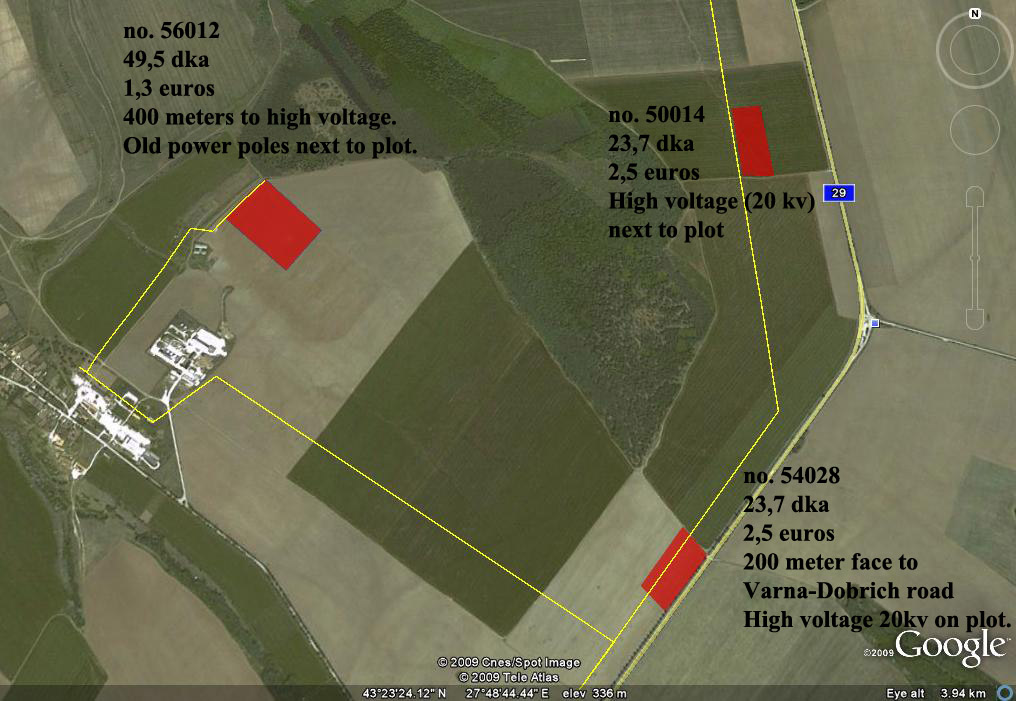
I have several large pieces of land suitable for green, alternative electricity generation. Renewable energy in Bulgaria is experience massive interest from investors as the land is cheap, the wind and solar conditions are good and the Bulgarian government has committed to long term (25 years) purchase of renewable energy units. Also, the the existing Bulgarian energy generation is aging and in dire need of change.


Example of land for sale in a village 25km North-west of Varna. This Bulgarian land is flat and perfect for photovoltaic solar panels or for wind turbines. The connection to the grid is possible.

Land for alternative, renewable energy and electricity generation in Bulgaria, near Varna


Solar energy in Bulgaria:

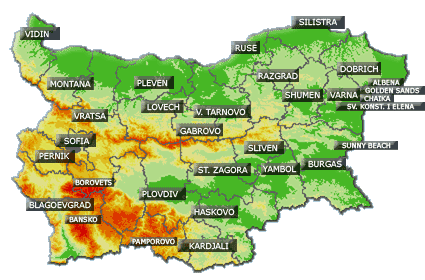
An alternative energy sources is solar energy which is practically inexhaustible.The solar radiation potential on Bulgaria’s territory is considerable but there is considerable difference in sunlight intensity in the different regions. Data analysis shows that Bulgaria’s territory can be divided into three solar zones; the average annual sunshine duration is roughly 2150 h which is about 49% of the maximum.

• Central-east region – occupies 40% of the country’s territory with 30% of its
population. That zone covers mountainous regions and is characterised by
inconsistence of micro-climatic conditions.
o Average annual sunshine duration 31 March – 31
October : Up to 1640h 
31 October – 31 March: Up to 400h
o Solar energy resource – 4kWh/m2 per day or 1450 kWh/m2per year

• North-east region – occupies 50% of the country’s territory with 60% of its
population. That zone covers agricultural regions, the industrial region and part of the
central north riverside strip.
o Average annual sunshine duration
31 March – 31 October:  Up to 1750h
31 October – 31 March: 400 - 500h
o Solar energy resource – 4.25 kWh/m2 per day or 1450 – 1500 kWh/m2 per
year

• Southeast and South-west region – occupies 10% of the country’s territory with
10% of its population. That zone includes the south coast.
o Average annual sunshine duration
31 March – 31 October: Over 1750h
31 October – 31 March: Over 500h
o Solar energy resource – 4.25 kWh/m2 per day or 1550 kWh/m2 per year


Wind energy in Bulgaria:

Wind and the energy generated from it have proven to be attractive for several reasons - wind is plentifully available, it is a cheap and virtually inexhaustible source of energy, and does not cause environmental damage or climatic anomalies. Briefly, it possesses properties, which none of the traditional energy sources used for generation of electricity can boast of. Operational costs for generation of energy, or rather the absence of fuel supply costs does make wind an especially attractive energy source in the eyes of investors.


The Bulgarian Government support
for alternative energy projects:

• Long-term period for obligatory purchase
of electricity based on renewable energy sources: 25 years for
solar and geothermal renewable energy electricity and
15 years for other renewable electricity sources
• Feed-in tariffs
• Obligatory connection to the electricity grid
• Guarantees of origin for the electricity
produced by RES as well as for the heat
and cooling energy
• Tax exemption for biofuels
• Obligatory blending for the distribution
companies of biofuels with mineral fuels


OTHER LINKS AND PROPERTY NEWS:


Maps of Bulgaria:      http://www.bgmaps.com

Holiday site for Bulgaria:  http://www.beachbulgaria.com/

Info about Varna, with photos:  http://varna-bulgaria.info/

Albena Resort website:  http://www.albena.bg

Bulgarian News in english: http://www.sofiaecho.com/

Search Google: www.google.com


okisen@yahoo.com
 
 
Article from Novinite.com about wind energy in Bulgaria an Romania.

Wind Picks up in Bulgaria, Romania

By Claudia Ciobanu
IPS


The natural conditions in Romania and Bulgaria make these countries some of the best placed in Europe for producing wind energy. Interest in investing in wind power is high in both countries, but legislative ambiguity and the limited capacity of national electricity grids are delaying the building of new wind parks.

Romania has the largest wind potential in south-east Europe, according to a study by Erste Bank last year. Its geographical and climatic conditions could eventually sustain an installed production capacity of 14,000 MW from wind. Even according to more modest estimates, wind power could potentially account for 10 percent of the energy produced in the country.

Bulgaria could have a wind power production capacity of 3,400 MW in a few years, according to the European Bank of Reconstruction and Development (EBRD). Unlike Romania, Bulgaria is at the moment highly dependent on energy imports, taking most of the fossil fuels it uses from Russia.

Apart from fossils and hydropower, Bulgaria is currently making use of a partially obsolete nuclear plant (Kozlodui), and planning to build another such plant in the north (Belene). Wind power could produce as much energy as these nuclear plants.

Southern Romania and northern Bulgaria, as well as areas along the Black Sea coast in both countries have the most favourable conditions for wind energy production. Among the companies interested in investing in wind power in these countries are Italian ENEL, Spanish Ibedrola and the U.S.-based AES Corporation.

Both countries have taken on the European Union (EU) objective of getting 20 percent of energy from renewable sources by 2020. But given that both Romania and Bulgaria have high hydroelectric capacities, the EU target could be achieved on the basis of hydropower, without replacing fossil fuels with renewables.

Even so, EU environmental legislation and the strong interest among foreign investors in exploiting wind power have been putting pressure on national authorities to act on promoting wind energy.

Bulgarian authorities seem to be moving faster, though Romania has more wind power potential.

Around 200 MW of wind farms are already installed in Bulgaria, and another 200 MW is in the pipeline, says Yordan Mihaylov, managing partner at MASS Energy Systems LLC, a company investing in renewable energy parks in Bulgaria and other countries. EBRD noted in a 2008 analysis that "Bulgaria's advantage, apart from the existing wind potential, is the supportive government with a pro-active regulatory approach."

"I would say that the Bulgarian legal framework is in a much better position than the Romanian one at the moment," Mihaylov told IPS. "Currently, the Bulgarian government issues 15 years contracts for 100 percent purchase of the electricity (produced by wind parks) at subsidised rates."

Most producers are likely to get a high percentage of their production subsidised at high rates, says Mihaylov. "There are still many gaps in the contracts that are issued, but I am happy to say that the government is working on fixing them."

On the other side of the border in Romania, less than 100 MW production capacity has been installed so far. Applications for projects adding up to 17,000 MW capacity have been filed by investors with the national electricity authority, but barely a fraction of this will materialise.

Some of the proposals are not serious, and so authorities are right to turn them down, says Radu Voinescu, managing partner at Boeru Voinescu Group, a leading wind energy consultancy in Romania.

Another reason for low acceptance of wind park proposals is that the national electricity grid can sustain at most 2000 MW wind power, says Voinescu. Wind power needs special adaptations of the grid to store energy for the times when the wind is not strong enough.

Expanding and adapting the electricity grid will need billions of euros, and political will to support renewables.

Unlike in Bulgaria, in Romania the purchase price for renewable energy has been left mainly to the market, making it tougher for producers to estimate profits and plan for the long term.

"Since 2008, we do have a law promoting renewables, through the use of green certificates and feed-in-tariffs (an incentive structure for renewables which means the state pledges to buy energy from renewables at above- market prices)," Voinescu told IPS. "But the methodological norms for implementing the law do not exist yet, and investors are left with many unanswered questions. Feed-in tariffs are not clarified in the law, so they remain just an option for the future."

"The Romanian government has chosen to attract mainly big investors," says Anka Zaion-Cicovski, international development representative of the French renewables company Valorem Energie. "Here, the purchasing tariffs are guaranteed for only one year, thus limiting the possibility for independent green electricity producers to access the market.

"The risk perceived by our financial partners is higher, and this makes project financing more complicated in Romania as compared to other countries such as France or Germany, where the feed-in tariffs are guaranteed for at least 12 years."

"Our politicians do not seem to be very interested in investing in the expansion of the national electricity grid (to take on more energy from renewables)," adds Radu Voinescu.

"But such an investment in infrastructure is exactly the type of investment that a country must take on in times of economic crisis. Romanian authorities have an obligation to invest in energy infrastructure and in education, without which the country has no future."


*Title changed by the Editorial Staff of Novinite.com


An article in Financial Times on Varna:

Varna: Black Sea town avoids demographic problems

By Kerin Hope


Published: July 8 2008 00:33 | Last updated: July 8 2008 00:33


Mothers wheeling babies in gleaming new pushchairs crowd the pedestrian concourse overlooking the Black Sea in central Varna, Bulgaria’s most flourishing port. Toddlers in sun hats and perched precariously on park benches eat ice cream.


Unlike other cities, Varna has escaped Bulgaria’s demographic problems – a low birth rate, an ageing workforce and high emigration – according to Kiril Yordanov, the mayor. Young people are flocking in, lured by jobs in retailing, tourism and a café lifestyle that compares, at least in the summer months, with that of Spain or Greece.
Varna’s population has almost doubled since 2001 to about 600,000 people and is growing faster than that of the capital, Sofia. Investment in the same period exceeded €1.5bn ($2.35bn), while unemployment is below 3 per cent, Mr Yordanov says.
“This is the only city in the country where the 18- to 30-year-olds outnumber the over-50s,” he says.
Varna’s transformation has taken place without the inflows of manufacturing investments that have enabled other neglected Balkan cities to prosper. But it has still managed to attract its share of foreign investors.
Fraport of Germany, which manages Varna and Burgas airports under a 35-year concession agreement, has undertaken to invest €400m in upgrading terminals and runways at both airports to international standards.
Eon, the German energy group, which acquired two electricity distributors in north-east Bulgaria following liberalisation of the energy sector, has set up a local headquarters in Varna’s new business park. Office buildings, warehouses and supermarkets are springing up along the airport road. Varna is a hub for tourists staying at St Constantine and Elena, Golden Sands and Albena, the three main northern Black Sea Bulgarian resorts which attract close to 3m visitors a year.

Jonathan White, a software expert from the UK who settled in Varna four years ago, says: “This is a good place to work because of the catch-up factor, which means there is a variety of opportunities”.In contrast with Burgas, Bulgaria’s second port 130km further south, Varna lacks heavy industry – with the exception of a shipbuilding facility controlled by Navibulgar, the state shipping line, which is to be sold to KG Maritime, a German-led shipping consortium.

Teodor Rokov, a local historian, says that, if refurbishment continues at the current pace, Varna will overtake Odessa as the most attractive port on the Black Sea rim. “Our climate is better and the city is on a more intimate scale. In my opinion, there’s nowhere in Ukraine or Georgia that matches it,” he says.
Yet Varna needs basic infrastructure improvements to achieve its potential. The domestic terminal at the airport needs to be refurbished. It takes more than five hours to drive the 500km to Sofia on a poor-quality highway. The railway line, the first that was built in Bulgaria, needs to be upgraded and rolling stock renewed.


To a large extent, the retail sector is driving growth as Bulgaria’s new middle class equips homes purchased with mortgages. By 2010, Varna will have four multi-storey shopping malls. The city is also the headquarters of Piccadilly supermarkets, the country’s largest food-retailing chain, which was acquired last year for €100m by Delta Maxi, the retailing arm of Serbia’s largest business group.

“The local customer base here is growing very fast, along with demand for more upscale products. Then you have added demand because of tourists and foreign homeowners,” says Aleksandar Camparevic, Piccadilly’s managing director.

Orchid Developments, a property company listed on London’s Aim market, is building one of the largest shopping malls in south-east Europe in Varna, with 50,000 square metres of retail space available for rent. Guy Meyohas, Orchid’s chief executive, says: “We’re more than a year away from opening and we’ve already accounted for about 60 per cent of the retail space, with some high-end brands appearing for the first time in Bulgaria”.

Demand for better-quality housing, as well as tourist development, is causing the city to expand along the coastline in both directions.

Alfa Developments, a Bulgarian real-estate group, has acquired a former military barracks on a cliff-top site 15 minutes’ drive from the port to build a self-contained neighbourhood with homes for about 4,000 residents.

“We want to create a real community with homes of different sizes and prices. It won’t be a second-home development for foreigners,” says Elitsa Panayotova, Alfa’s chief executive.

Varna’s ambitious master plan, due to be implemented by 2014, would bring about another transformation. A €600m project backed by Japan’s international investment bank provides for widening and deepening a canal linking the commercial port with a lake on the west of the city.
“The port is right in the middle of the historic centre of the city. When it is moved, we’ll be able to create a unique waterfront for all our citizens to enjoy,” says Mr Yordanov.
The shipyard and port facilities would be relocated on the lake, freeing up space for a large marina and new waterfront developments. A second bridge across the canal would be built to carry increasing numbers of trucks travelling from Turkey to central Europe.


European farmland hits record prices

By Andrew Bounds in Brussels

Published: April 23 2008 18:34 | Last updated: April 24 2008 08:23

With prices of commercial and residential property falling, investors are increasingly turning to a more traditional asset: farmland. Long seen as a declining industry, farming has received a fillip in the last few months as global demand for food has increased. As a result, the cost of agricultural holdings across the European Union has risen to record levels.

In response several funds have recently been set up to buy farmland. In particular the UK, where prices have risen 40 per cent over the last year, has been active. Braemar, a fund manager, is one example. The Manchester-based group has been swamped with offers since it launched a fund this year.

While Braemar faced stiff opposition from farmers looking to expand, he said many were also looking to cash out after 20 years of flat land prices.

Braemar has also opened an offshore open-ended investment fund in Guernsey. “We have everyone from pensioners looking to avoid inheritance tax to stockbrokers looking for a secure investment,” he said.

Subsidy support

Germany joined forces with France on Wednesday in support of maintaining subsidies to farmers after 2013, when a new EU budget regime begins.

“Of course we could reduce direct payments to farmers if their incomes improved and the price situation allowed, but we shouldn’t scrap the payments as some, such as the UK, suggest,” said Gerd Lindemann, state secretary at the agriculture ministry in Berlin.


Andrew Shirley, head of rural research at Knight Frank, a property company that is establishing its own agricultural investment fund, said land prices were rising across Europe.

“It is not only UK land values that are increasing sharply, the global commodities boom means investment funds are looking further afield for cheap land and this is helping to drive prices up, particularly in eastern Europe and the former Soviet bloc where there are vast tracts of underutilised and potentially very productive land,” he said.

In Poland the US embassy reports that average prices rose 60 per cent between 2003 and 2006.

Even Serbia, another non-EU country, has seen a steep increase. Real estate analysts estimate arable land prices this year in Serbia’s agriculturally rich northern region, Vojvodina, at roughly €7,000-€8,000 per hectare this year, up sharply from €5,000 last year.

Foreigners cannot buy land in Poland until 2016, while other countries have also slapped on shorter bans to prevent outsiders cashing in. However, it is simple for investors to set up a local company to bypass the rules.

Countries with sales restrictions, such as France, are cheapest. Land is about €6,000 a hectare there because it must be offered first to young local farmers. However, land prices are still 50 per cent up on 2003.

Farmers say that stricter environmental rules are also causing higher prices. “You need more land to produce the same amount,” said Peter Gemaelke, head of the Danish farmers’ union. He said a recent reduction in the amount of nitrogen that could be used per hectare had lowered yields.

However, as investors eye the prospect of harvesting good returns, some observers caution against too much euphoria. “Until there is greater clarity about the depth of the problems facing the economy, one must add a note of caution,” said Mark McAndrew from Strutt & Parker, a UK-based property agency.

Additional reporting by Neil MacDonald in Belgrade, Guy Dinmor


Agricultural land most attractive property in Bulgaria, consultancy firm says

16:52 Tue 15 Jul 2008 - Svetlana Guineva
 

Holiday resorts and big Bulgarian cities do not seem such an attractive investment opportunity for foreign property investors any longer. Now, an increasing number of private and institutional investors see more value and profitability in agricultural and development land, consultants at Sash Property Solutions (SPS) said as quoted by nubricks.com, UK property blog.

SPS does an independent research of the Bulgarian real estate market and its recent findings showed that prices of agricultural land had risen by 40 per cent. The consultant company attributed this new trend to the lower risk and less involvement for potential buyers as opposed to buy-to-let and commercial properties. Compared to other European countries, agricultural land in Bulgaria much cheaper.

The tendency was to buy agricultural land in an attractive location, go through the process of regulation and re-sell it for a handsome profit, SPS advised. The downside of this procedure was the regulation process, which turned out to be a long, frustrating and time-consuming effort.

Nubricks.com quoted a former investor in agricultural land near Bourgas, who bought the property for nine euro a sq m. Two years later, after completing the regulation procedure, the owner sold the plot for 60 euro a sq m to a developer whose intention was to build holiday houses.

The property consultants also suggested that land in the periphery of the big cities appeared to be a good investment as well. Most cities’ development planning would soon feature enlargement toward the available vicinity plots. In a long run, the land price will increase and generate an easy profit at minimum risk, SPS said.


Back to home page: www.bulgarialandsale.com

-Български недвижими имоти новини. евтини български имоти за продажба в Варна, Златни Пясъци и Албена.
-Болгарский недвижимости. дешевые болгарские собственность на продажу в Варна, Золотые Пески и   Албена.Болгарский недвижимости. Сайт для земельных инвестиций в Болгарии, сельскохозяйственные земли в Болгарии, строительные участки в Албена Камчия и курортов, и дешевых земельных участков Варна, Албена, Балчик.

KEYWORDS: Bulgaria property. Bulgarian property. Bulgarian properties. bulgarian real estate. Konstantinovo. varna. varna property. Bulgaria land. land in bulgaria. land sale. land for sale. cheap land bulgaria. osenovo. kamchia. bliznaci. blisnatsi. bulgaria golden sands. albena. golf land bulgaria. black sea property. Болгария недвижимость. Болгарский земли гольфа, Варна. Черное море. Константиново. дешевые земли Болгарии, bliznaci, Болгария Золотые Пески, България недвижими имоти. Българската земя от голф игрището, Варна. Черно море. Константиново. евтина земя парцел България, bliznaci, България, Златни пясъци. overseas property. Bulgaria. bulgaria, bulgaria,land,solar,photovoltaic,wind,renewable,energy, alternative, green energy, vind energi, sonnen energie, electricity land, plot, building plot, bulgaria property investment, agricultural land bulgaria, farmland, Varna land, Rogachevo, Albena, bulgarian land,property in bulgaria, land for sale, land for sale in bulgaria,cheap land, buy land, grunde bulgarien, landbrugsjord bulgarien, køb landbrugsjord, bulgarien, bulgaria land, konstantinovo, golf course varna, albena golf, balchik, osenovo, albena golf course, black sea, company registraion bulgaria, property taxes bulgaria, България, недвижими имоти, bulgaria property, Болгария недвижимость. Болгарский земли гольфа, Варна. Черное море. Константиново. дешевые земли Болгарии, bliznaci, Болгария Золотые Пески, България недвижими имоти. Българската земя от голф игрището, Варна. Черно море. Константиново. евтина земя парцел България, bliznaci, България, Златни пясъци. overseas property, Erneuerbare Energien, regenerative Energien, Alternativenergien, Solarenergie, Windenergie, Windkraftanlagen, Strom, alternative, umweltfreundliche Energie, erneuerbare Energien, Photovoltaik, Sonnenenergie, Sonnenkollektoren, Windmühlen, Windenergieanlage, Photovoltaikanlage, Sonnenkollektor,  Windpark ,


Land in Bulgaria.Varna property * HOME*bottom menuBulgarian land in BLIZNACI/VARNA LAND (Близнаци)bottom menuALBENA LAND by OSENOVO (Осеново) IN BULGARIAbottom menuVarna property : KONSTANTINOVO LAND (Константиново, Варна)bottom menuAGRICULTURAL LAND IN BULGARIA, CHEAP.bottom menu*CONTACT* How to buy in Bulgariabottom menuWind/Solar Power in Bulgaria + Articles